


Crystal Structure Prediction via Ionic Substitutions#
This notebook demonstrates how to use the SMACT structure_prediction module.
1. Getting Started#

# Install the required packages
try:
    import google.colab

    IN_COLAB = True
except:
    IN_COLAB = False

if IN_COLAB:
    !uv pip install smact[optional] --quiet
# Import the required packages
import os
from operator import itemgetter

import pandas as pd

from smact.structure_prediction.database import StructureDB, parse_mprest
from smact.structure_prediction.mutation import CationMutator
from smact.structure_prediction.prediction import StructurePredictor
from smact.structure_prediction.structure import SmactStructure
from smact.structure_prediction.utilities import parse_spec, unparse_spec
from mp_api.client import MPRester
import pymatviz as pmv
from pymatgen.core import SETTINGS


import seaborn as sns
import matplotlib.pyplot as plt

sns.set_theme(context="notebook")
2. Introducing the Structure Prediction Module#
The SmactStructure class#
Here we will introduce users to the SmactStructure class which is used in the Structure Prediction module to represent structures. We can create instances of the SmactStructure class from POSCAR files, pymatgen Structure objects, or directly from a list of atomic positions and lattice vectors. We can also get the SmactStructure from the Materials Project database using the from_mp method.
For the example below, we will get a structure of CsPbI3 from the Materials Project.
# Set your MP API key
os.environ["MP_API_KEY"] = "<YOUR_MP_API_KEY>"
# We need to specify a list containing tuples of (element, oxidation state, stoichiometry)
cspbi3_species = [("Cs", 1, 1), ("Pb", 2, 1), ("I", -1, 3)]

cspbi3_sstruct = SmactStructure.from_mp(species=cspbi3_species)
# We can print the SmactStructure object. This will show the structure in a POSCAR-like format
print("SmactStructure object:")
print(cspbi3_sstruct)

# We can visualise the structure as well
pmv.structure_2d(cspbi3_sstruct.as_py_struct())
SmactStructure object:
Cs1+ I1- Pb2+
1.0
6.27514229 0.0 -0.0
0.0 6.27514229 0.0
0.0 0.0 6.27514229
Cs I Pb
1 3 1
Cartesian
3.137571145 3.137571145 3.137571145 Cs1+
0.0 0.0 3.137571145 I1-
0.0 3.137571145 0.0 I1-
3.137571145 0.0 0.0 I1-
0.0 0.0 0.0 Pb2+
<Axes: >
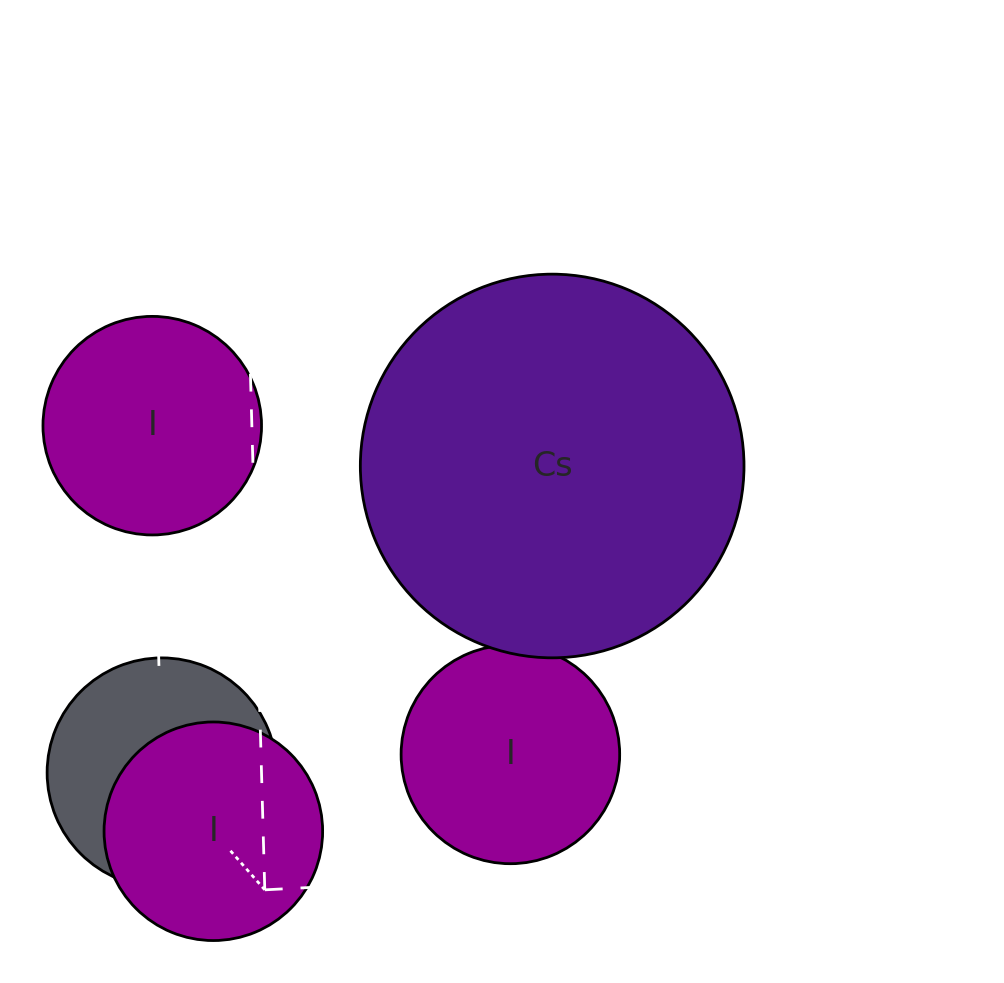
For a SmactStructure object, we can get the list of species present
# Print the species in CsPbI3
print(f"Species in CsPbI3:")
print("Element, Valence, Stoichiometry")
for spec in cspbi3_sstruct.species:
    print(spec)

# We can also print out just the string representation of the species
print(f"\nSpecies in CsPbI3: {cspbi3_sstruct.get_spec_strs()}")

# We can also check if a SmactStructure contains a specific species
has_cs1 = cspbi3_sstruct.has_species(("Cs", 1))
print(f"\nDoes the CsPbI3 structure contain Cs?: {has_cs1}")
Species in CsPbI3:
Element, Valence, Stoichiometry
('Cs', 1, 1)
('I', -1, 3)
('Pb', 2, 1)

Species in CsPbI3: ['Cs1+', 'I1-', 'Pb2+']

Does the CsPbI3 structure contain Cs?: True
We will return to using the SmactStructure object in the next section.
The CationMutator class#
Here we will introduce users to the CationMutator in smact.structure_prediction.mutation module. The CationMutator class is used to handle the substitution probabilities of different ionic species.
We can use the sub_prob method to get the substitution probabilities of two different ionic species. The sub_prob method takes two arguments, the first argument is the ionic species to be substituted, and the second argument is the ionic species to be substituted with. The sub_prob method returns the substitution probability of the two ionic species.
Additionally, the pair_corr method computes the pair correlation.
# Instantiate the CationMutator class

mutator = CationMutator.from_json()  # This gets the pymatgen lambda table when no arguments are passed

# Calculate the probability of Ba2+ replacing Sr2+,  Ba2+ replacing Cs1+ and Ba2+ replacing Li1+ in the lambda table

p_Ba_Sr = mutator.sub_prob("Ba2+", "Sr2+")
p_Ba_Cs = mutator.sub_prob("Ba2+", "Cs1+")
p_Ba_Li = mutator.sub_prob("Ba2+", "Li1+")

# Calculate the pair correlation function for Ba2+ replacing Sr2+,  Ba2+ replacing Cs1+ and Ba2+ replacing Li1+ in the lambda table
g_Ba_Sr = mutator.pair_corr("Ba2+", "Sr2+")
g_Ba_Cs = mutator.pair_corr("Ba2+", "Cs1+")
g_Ba_Li = mutator.pair_corr("Ba2+", "Li1+")

# Print the results
print(f"The probability of Ba2+ replacing Sr2+ is {p_Ba_Sr:.3g} and the pair correlation is {g_Ba_Sr:.3g}")
print(f"The probability of Ba2+ replacing Cs1+ is {p_Ba_Cs:.3g} and the pair correlation is {g_Ba_Cs:.3g}")
print(f"The probability of Ba2+ replacing Li1+ is {p_Ba_Li:.3g} and the pair correlation is {g_Ba_Li:.3g}")
The probability of Ba2+ replacing Sr2+ is 0.00276 and the pair correlation is 3.86
The probability of Ba2+ replacing Cs1+ is 0.00569 and the pair correlation is 3.99
The probability of Ba2+ replacing Li1+ is 2.21e-05 and the pair correlation is 0.038
From the above outputs, we can see that Ba2+ is more likely to be substituted with Cs+, compared to Sr2+ with Li+ being two orders of magnitude less likely.
The CationMutator can also be used to produce a list of possible structures with the unary_substitute method. The unary_substitute method takes a SmactStructure object and returns a list of SmactStructure objects with the cations substituted according to the substitution probabilities.
# Let's substitute on CsPbI3

candidate_structures = list(mutator.unary_substitute(cspbi3_sstruct, thresh=0.001))

# Print the number of candidate structures
print(f"Number of candidate structures: {len(candidate_structures)}")

# Print the composition of the first candidate structure
print(f"Composition of the first candidate structure:")
print(candidate_structures[0][0].reduced_formula())

# Print the probability of the first candidate structure
original_spec = candidate_structures[0][2]
sub_spec = candidate_structures[0][3]
prob = candidate_structures[0][1]
print(f"The probability of {sub_spec} replacing {original_spec} in {cspbi3_sstruct.reduced_formula()} is {prob:.3g}")

# Visualise the original structure and the first candidate structure
pmv.structure_2d([cspbi3_sstruct.as_py_struct(), candidate_structures[0][0].as_py_struct()])
Number of candidate structures: 59
Composition of the first candidate structure:
AgPbI3
The probability of Ag1+ replacing Cs1+ in CsPbI3 is 0.0262
(<Figure size 1200x600 with 2 Axes>,
 array([<Axes: title={'center': '1. Cs1 Pb1 I3 (spg=221)'}>,
        <Axes: title={'center': '2. Ag1 Pb1 I3 (spg=221)'}>], dtype=object))
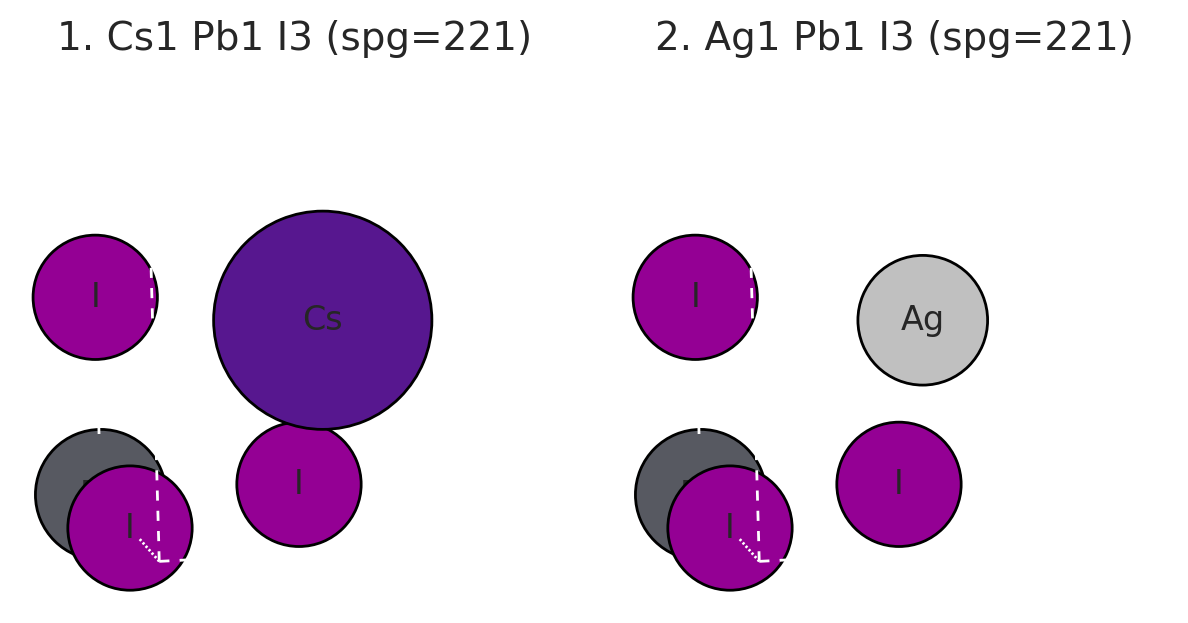
Overall, with the threshold of 1 x 10⁻³, there are 59 possible substituted structures for CsPbI3. The returned list isn’t sorted by probability, so let’s first organise the list.
# Store the candidate structures in a dataframe

candidate_df = pd.DataFrame(
    candidate_structures, columns=["Structure", "Probability", "Original Species", "Substituted Species"]
)
# Sort the dataframe by probability
candidate_df = candidate_df.sort_values(by="Probability", ascending=False).reset_index(drop=True)

# Show the first 5 rows of the dataframe
candidate_df.head()
| Structure | Probability | Original Species | Substituted Species | |
|---|---|---|---|---|
| 0 | I1- Pb2+ Rb1+\n1.0\n6.27514229 0.0 -0.0\n0.0 6... | 0.165778 | Cs1+ | Rb1+ |
| 1 | Br1- Cs1+ Pb2+\n1.0\n6.27514229 0.0 -0.0\n0.0 ... | 0.138700 | I1- | Br1- |
| 2 | I1- Pb2+ Tl1+\n1.0\n6.27514229 0.0 -0.0\n0.0 6... | 0.102270 | Cs1+ | Tl1+ |
| 3 | I1- K1+ Pb2+\n1.0\n6.27514229 0.0 -0.0\n0.0 6.... | 0.089402 | Cs1+ | K1+ |
| 4 | I1- In1+ Pb2+\n1.0\n6.27514229 0.0 -0.0\n0.0 6... | 0.086309 | Cs1+ | In1+ |
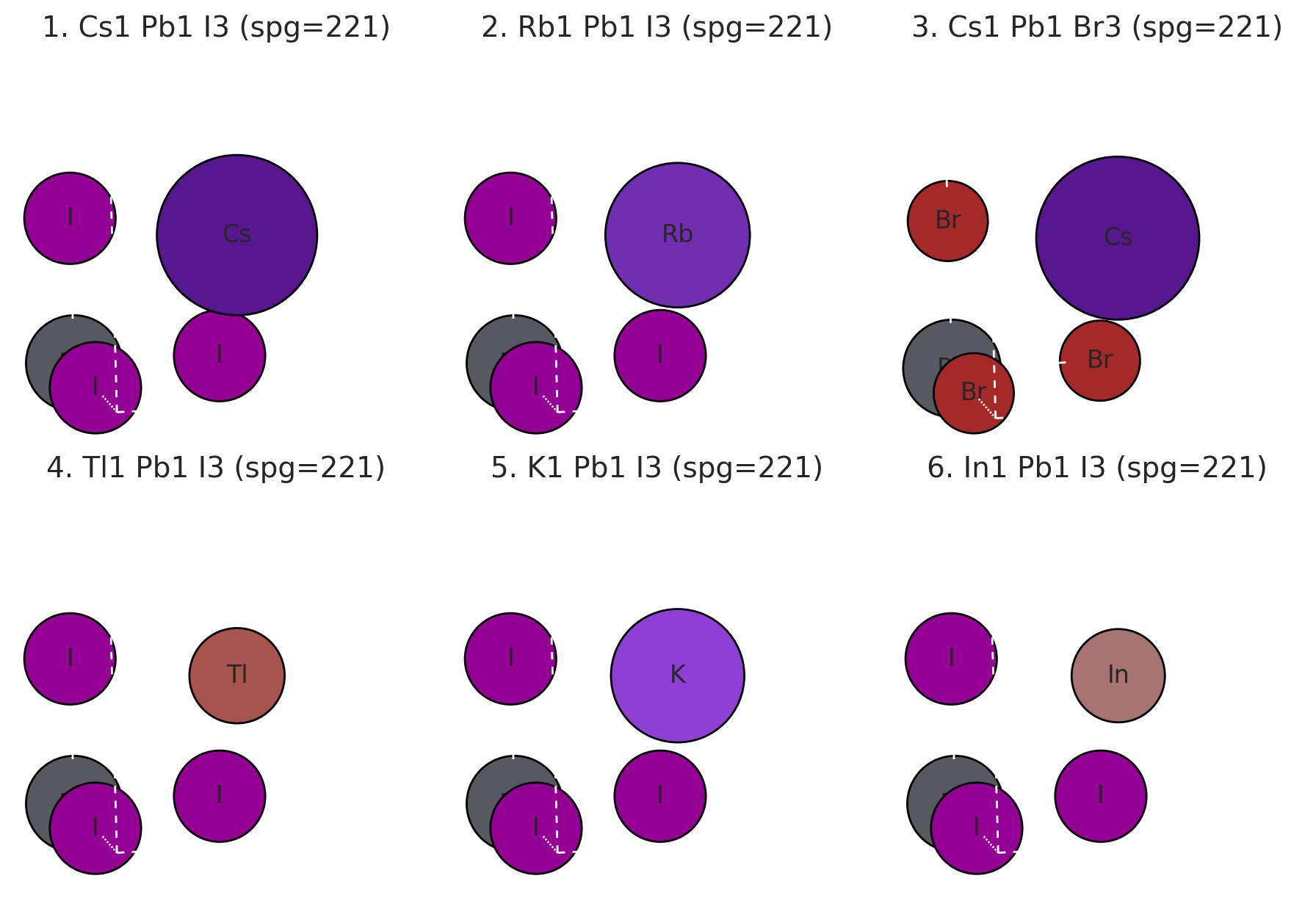
From the dataframe above, we can see that the most probable substitution is Cs+ with Rb+ with a probability of 0.166, followed by the substitution of of I- with Br- with a probability of 0.139.
# Visualise the top 5 candidate structures
top_5_structures = [s.as_py_struct() for s in candidate_df["Structure"].head().to_list()]
pmv.structure_2d([cspbi3_sstruct.as_py_struct()] + top_5_structures, n_cols=3)
(<Figure size 1800x1200 with 6 Axes>,
 array([[<Axes: title={'center': '1. Cs1 Pb1 I3 (spg=221)'}>,
         <Axes: title={'center': '2. Rb1 Pb1 I3 (spg=221)'}>,
         <Axes: title={'center': '3. Cs1 Pb1 Br3 (spg=221)'}>],
        [<Axes: title={'center': '4. Tl1 Pb1 I3 (spg=221)'}>,
         <Axes: title={'center': '5. K1 Pb1 I3 (spg=221)'}>,
         <Axes: title={'center': '6. In1 Pb1 I3 (spg=221)'}>]],
       dtype=object))
The StructureDB class#
Here we will introduce users to the StructureDB class. This is a minimalist SQLite database that stores SmactStructure objects.
# This either creates a new database or connects to an existing one
#
if os.path.exists("test_db.db"):
    os.remove("test_db.db")
test_db = StructureDB("test_db.db")

# Add a table
test_db.add_table("test_table")

# Add the original structure to the database
test_db.add_struct(struct=cspbi3_sstruct, table="test_table")

# Add the candidate structures to the database
test_db.add_structs(structs=[s[0] for s in candidate_structures], table="test_table")
59
# Get the structures from the database

# Get structs that contain Cs1+

cs_structs = test_db.get_with_species(species=[("Cs", 1)], table="test_table")

# Print the number of structures
print(f"There are {len(cs_structs)} structures that contain Cs1+")

# Get structs that contain Cs1+ and Pb2+

cs_pb_structs = test_db.get_with_species(species=[("Cs", 1), ("Pb", 2)], table="test_table")

# Print the number of structures

print(f"There are {len(cs_pb_structs)} structures that contain Cs1+ and Pb2+")
There are 42 structures that contain Cs1+
There are 4 structures that contain Cs1+ and Pb2+
The above code blocks demonstrates how to create a StructureDB object, store a list of SmactStructure objects, and retrieve a list of SmactStructure objects from the database by the species present in the structure.
The following example demonstrates how to obtain structures from the Materials Project* and store them in the StructureDB object.
* The below code assumes that the user has a Materials Project API key from the current (next-gen) version of the MP. If you do not have one, you can obtain one by signing up at https://materialsproject.org/
# The below function will return a list of perovskite data from the Materials Project database. The specifics of the code are not important for this tutorial.


def get_MP_perovskite_data(api_key=None):
    if api_key is None:
        api_key = os.environ.get("MP_API_KEY") or SETTINGS.get("PMG_MAPI_KEY")
    if api_key is None:
        raise ValueError("No API key found in environment or Pymatgen config file. Please provide an API key.")

    # Get perovskite data from the Materials Project
    with MPRester(api_key=api_key, use_document_model=False) as mpr:
        robocrys_perov_data = mpr.materials.robocrys.search(keywords=["perovskite"])

    # Get the material ids
    mp_ids = list(set([d.material_id for d in robocrys_perov_data]))

    # Get the ABO3 perovskites
    with MPRester(api_key=api_key, use_document_model=False) as mpr:
        perov_data = mpr.materials.summary.search(
            material_ids=mp_ids,
            theoretical=False,
            formula="ABC3",
            fields=["material_id", "formula_pretty", "structure", "formula_anonymous", "energy_above_hull"],
        )

    return perov_data


# Get the perovskite data
perov_data = get_MP_perovskite_data()
# Parse the data to SmactStructure objects

test_db.add_mp_icsd(table="mp_icsd_perovskites", mp_data=perov_data)
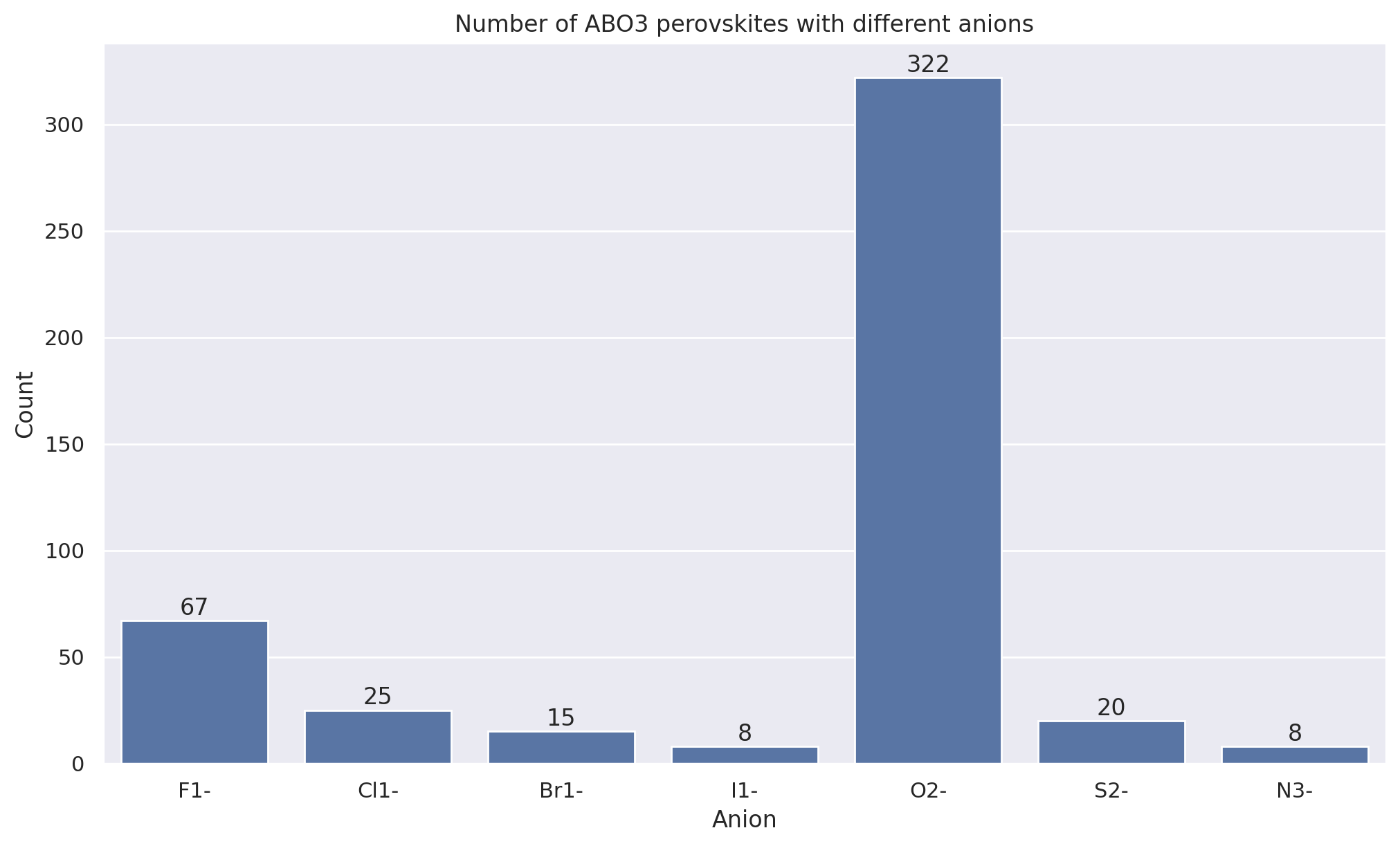
From the above code block we have successfully added 484 out of the 753 ABX3 perovskite structures from the Materials Project to the StructureDB object. Structures which cannot be assigned oxidation states are discarded. We can now use the StructureDB object to retrieve structures based on the species present in the structure.
# Count the number of perovskites with different anions in the database

anions = ["F1-", "Cl1-", "Br1-", "I1-", "O2-", "S2-", "N3-"]

anion_counts_dict = {}

for anion in anions:
    anion_counts_dict[anion] = len(test_db.get_with_species(species=[parse_spec(anion)], table="mp_icsd_perovskites"))

# Print the counts
print("Number of perovskites with different anions:")
for anion, count in anion_counts_dict.items():
    print(f"{anion}: {count}")


# Plot the number of perovskites with different anions
anion_counts_df = pd.DataFrame(anion_counts_dict.items(), columns=["Anion", "Count"])

fig, ax = plt.subplots(figsize=(10, 6))
sns.barplot(x="Anion", y="Count", data=anion_counts_df, ax=ax)
# Show values on the bars
for i, v in enumerate(anion_counts_df["Count"]):
    ax.text(i, v + 0.5, str(v), ha="center", va="bottom")

ax.set_title("Number of ABO3 perovskites with different anions")
plt.show()
Number of perovskites with different anions:
F1-: 67
Cl1-: 25
Br1-: 15
I1-: 8
O2-: 322
S2-: 20
N3-: 8
The StructurePredictor class#
With a populated database, we can now introduce the final aspect of the Structure Prediction module, the StructurePredictor class. The StructurePredictor class is used to predict possible structures of a given composition. The StructurePredictor class requires a populated StructureDB object and a CationMutator object,
# Instantiate the StructurePredictor class
predictor = StructurePredictor(mutator=mutator, struct_db=test_db, table="mp_icsd_perovskites")
To predict possible structures for a given set of ionic species, we can use the predict_structs method. The predict_structs method takes a list of ionic species and the probability threshold as arguments. The return format is a generator which yields tuples of the form (predicted structure, probability, original structure).
# Define a composition which contains the ions Zr4+, Ta5+ and N3-
Zr_Ta_N_species = [
    ("Zr", 4),
    ("Ta", 5),
    ("N", -3),
]
parsed = [unparse_spec(s) for s in Zr_Ta_N_species]
threshold = 0.001
# Predict the possible structures that Zr4+, Ta5+ and N3- can be substituted onto
result = predictor.predict_structs(species=Zr_Ta_N_species, thresh=0.001, include_same=False)

# Show the first result

result_0 = next(result)

print(result_0)

print(
    f"\nUsing a threshold of {threshold}, the species {parsed} can be substituted into the structure of {result_0[2].reduced_formula()} with probability {result_0[1]:.3g}"
)

# Visualise the predicted and template structure

structs = [result_0[0].as_py_struct(), result_0[2].as_py_struct()]

pmv.structure_2d(structs)
plt.show()
(N3- Ta5+ Zr4+
1.0
4.064437 0.0 0.0
0.0 4.064437 0.0
0.0 0.0 4.064437
N Ta Zr
3 1 1
Cartesian
2.0322185 0.0 2.0322185 N3-
2.0322185 2.0322185 0.0 N3-
0.0 2.0322185 2.0322185 N3-
2.0322185 2.0322185 2.0322185 Ta5+
0.0 0.0 0.0 Zr4+
, np.float64(0.02012124833175394), N3- Ta5+ Th4+
1.0
4.064437 0.0 0.0
0.0 4.064437 0.0
0.0 0.0 4.064437
N Ta Th
3 1 1
Cartesian
2.0322185 0.0 2.0322185 N3-
2.0322185 2.0322185 0.0 N3-
0.0 2.0322185 2.0322185 N3-
2.0322185 2.0322185 2.0322185 Ta5+
0.0 0.0 0.0 Th4+
)

Using a threshold of 0.001, the species ['Zr4+', 'Ta5+', 'N3-'] can be substituted into the structure of ThTaN3 with probability 0.0201
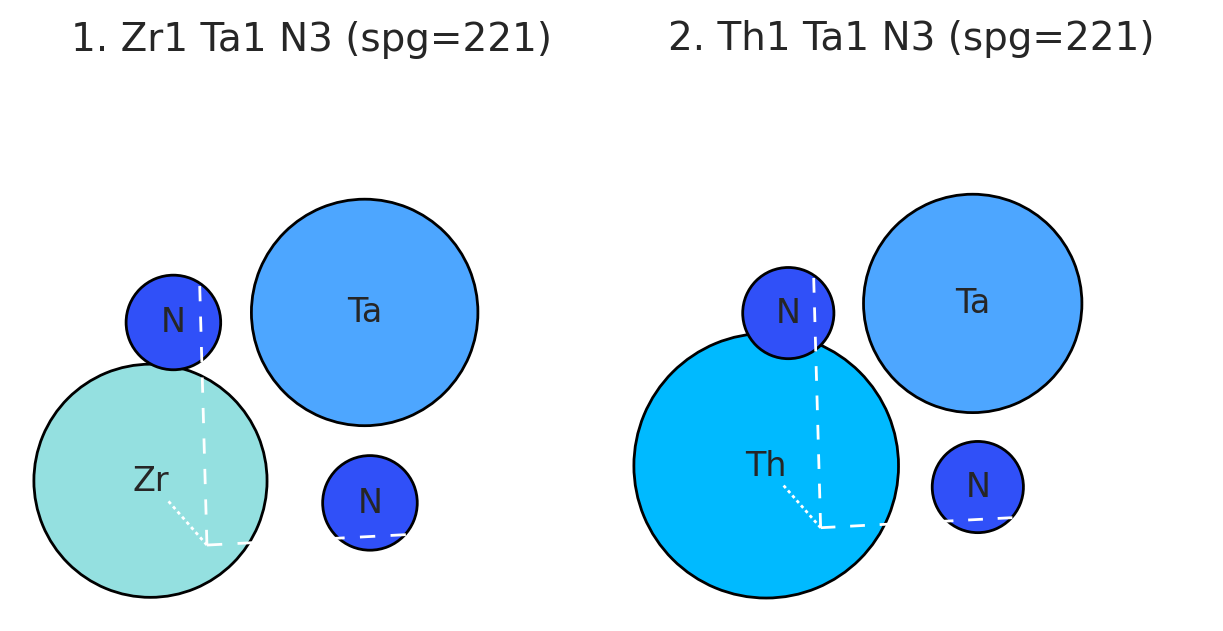
Using the StructurePredictor class, we have shown that we can assign (Zr4+, Ta5+, N3-) to the perovskite ThTaN3, where Zr4+ substitutes for Th4+ with probability 0.0201.
We will show an example below, where we try to substitute the species (Cs+, Pb2+, I-) into the structures in our database.
cs_pb_I_species = [
    ("Cs", 1),
    ("Pb", 2),
    ("I", -1),
]

# Get the results for the substitution
cspbi_results = list(predictor.predict_structs(species=cs_pb_I_species, thresh=0.001, include_same=False))

# Sort the results by probabiblity
cspbi_results.sort(key=itemgetter(1), reverse=True)

for result in cspbi_results:
    print(
        f"The composition {result[0].reduced_formula()} has a probability of {result[1]:.3g} of substiutuing into the structure of {result[2].reduced_formula()}"
    )

# Visualise the predicted and original structures

predicted_structs = [result[0].as_py_struct() for result in cspbi_results]
db_structs = [result[2].as_py_struct() for result in cspbi_results]
structures = predicted_structs + db_structs


pmv.structure_2d(structures, n_cols=8)
plt.show()
The composition CsPbI3 has a probability of 0.139 of substiutuing into the structure of CsPbBr3
The composition CsPbI3 has a probability of 0.139 of substiutuing into the structure of CsPbBr3
The composition CsPbI3 has a probability of 0.066 of substiutuing into the structure of CsPbCl3
The composition CsPbI3 has a probability of 0.0473 of substiutuing into the structure of CsSnI3
The composition CsPbI3 has a probability of 0.0473 of substiutuing into the structure of CsSnI3
The composition CsPbI3 has a probability of 0.0175 of substiutuing into the structure of CsDyI3
The composition CsPbI3 has a probability of 0.00415 of substiutuing into the structure of CsPbF3
The composition CsPbI3 has a probability of 0.00415 of substiutuing into the structure of CsPbF3
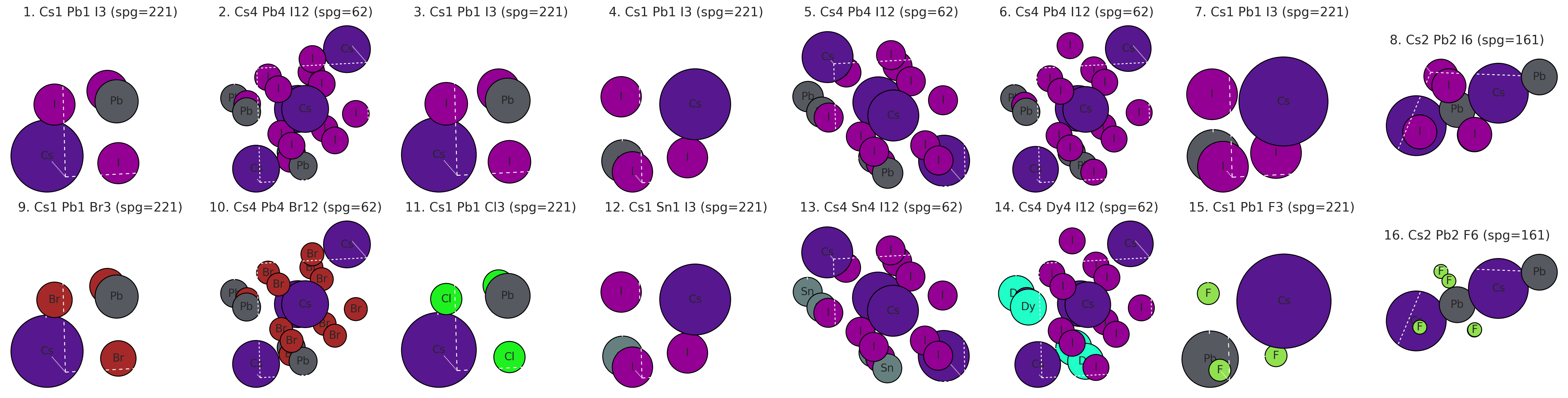
The visualisation above depicts all the CsPbI3 structures in the top row, and their templates in the bottom row.
2. Next Steps#
This notebook has provided a simple introduction to the Structure Prediction module in SMACT.
For more advance work:
Use the
smact_filterfunction to build up a search space and attempt to predict the eneumerated compositions in a high-throughput mannerUse the predicted structures as inputs to DFT/MLFF relaxation calculations
Develop their own probability models to use with the
CationMutatorclass.