

Predicting Properties from Composition#
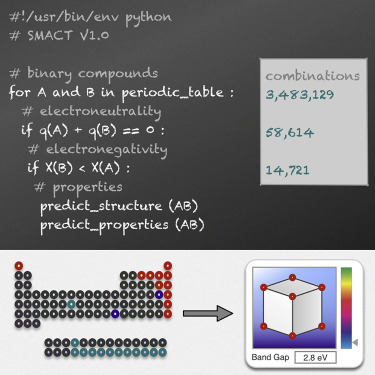
SMACT includes a property prediction module that uses pretrained ROOST (Representation Learning from Stoichiometry) models to predict material properties from chemical composition alone — no crystal structure required.
This notebook demonstrates how to:
Predict band gaps with a single function call
Use the
RoostPropertyPredictorclass for more controlGet uncertainty estimates on predictions
Query the model registry
Combine property prediction with SMACT screening
Prerequisites#
The property prediction module requires torch and aviary-models, which can be installed via:
pip install smact[property_prediction]
Or if installing from source:
uv sync --extra property_prediction
1. Quick start — predict_band_gap#
The simplest way to predict band gaps is with the convenience function. It accepts a single composition string or a list of strings.
from smact.property_prediction import predict_band_gap

# Predict band gap for a single material
bg = predict_band_gap("GaN")
print(f"GaN predicted band gap: {bg[0]:.2f} eV")
# Predict band gaps for multiple materials at once
compositions = ["NaCl", "TiO2", "GaN", "Si", "ZnO", "CdTe", "GaAs", "SrTiO3"]
predictions = predict_band_gap(compositions)

for comp, bg in zip(compositions, predictions, strict=True):
    print(f"  {comp:10s} → {bg:.2f} eV")
2. Using RoostPropertyPredictor#
For more control, use the RoostPropertyPredictor class directly. This allows you to:
Reuse a loaded model across multiple prediction calls
Access model metadata
Request uncertainty estimates
from smact.property_prediction import RoostPropertyPredictor

# Create a predictor (loads the model once)
predictor = RoostPropertyPredictor(property_name="band_gap")

# Make predictions — the model stays loaded between calls
result_1 = predictor.predict(["NaCl", "KCl", "LiF"])
result_2 = predictor.predict(["Fe2O3", "Al2O3"])

print("Alkali halides:", result_1)
print("Oxides:", result_2)
3. Uncertainty quantification#
The ROOST model is trained with a heteroscedastic (robust) loss, which means each prediction comes with an aleatoric uncertainty estimate — the model’s confidence that varies per sample.
Pass return_uncertainty=True to get a PredictionResult object.
# Get predictions with uncertainty
result = predictor.predict(
    ["NaCl", "TiO2", "GaN", "Si", "ZnO", "CdTe"],
    return_uncertainty=True,
)

print(f"Result type: {type(result).__name__}")
print(f"Unit: {result.unit}")
print(f"Number of predictions: {len(result)}")
print()

for comp, pred, unc in zip(
    result.compositions, result.predictions, result.uncertainties, strict=True
):
    print(f"  {comp:8s} → {pred:.2f} ± {unc:.2f} eV")
# PredictionResult can be converted to a dictionary for serialisation
import pprint

pprint.pprint(result.to_dict())
4. Querying the model registry#
The registry tracks which properties have pretrained models, what fidelity levels are available, and which models are installed.
from smact.property_prediction import (
    get_available_models,
    get_supported_properties,
)
from smact.property_prediction.registry import (
    get_property_description,
    get_property_unit,
)

# What properties can we predict?
properties = get_supported_properties()
print("Supported properties:")
for prop in properties:
    unit = get_property_unit(prop)
    desc = get_property_description(prop)
    print(f"  {prop}: {desc} [{unit}]")

print()

# What models are available?
models = get_available_models()
print("Available models:")
for model in models:
    print(f"  {model}")
5. Combining with SMACT screening#
A powerful workflow is to first use SMACT’s chemical filters to generate candidate compositions, then predict their properties. Here we screen ternary oxides and predict their band gaps.
import smact
from smact.screening import smact_filter

# Screen for valid Zn-Sn-O compositions
elements = [smact.Element(sym) for sym in ["Zn", "Sn", "O"]]
valid = smact_filter(elements, threshold=4)

# Build composition strings from the filter output
compositions = []
for els, _charges, stoichs in valid:
    formula = "".join(
        f"{el}{s}" if s > 1 else el for el, s in zip(els, stoichs, strict=True)
    )
    compositions.append(formula)

# Remove duplicates and predict band gaps
compositions = sorted(set(compositions))
print(f"Found {len(compositions)} unique compositions from SMACT filter")
print()

# Predict band gaps for all candidates
results = predictor.predict(compositions, return_uncertainty=True)

# Show results sorted by predicted band gap
import numpy as np

order = np.argsort(results.predictions)
print(f"{'Composition':>15s}  {'Band gap (eV)':>14s}  {'Uncertainty':>12s}")
print("-" * 46)
for i in order:
    print(
        f"{compositions[i]:>15s}  {results.predictions[i]:>10.2f} eV  "
        f"± {results.uncertainties[i]:.2f} eV"
    )
Notes#
Model: The default model is ROOST trained on ~103K Materials Project DFT band gaps (PBE functional). It achieves an MAE of 0.28 eV and R² of 0.93 on the test set.
Input: Compositions should be standard chemical formulas (e.g.,
"NaCl","TiO2","Ba2YCu3O7"). The model is composition-only — polymorphs with the same formula will give the same prediction.Uncertainty: Aleatoric uncertainties come from the heteroscedastic loss. Larger uncertainties indicate compositions where the model is less confident (e.g., outside the training distribution).
Device: Pass
device="cuda"toRoostPropertyPredictororpredict_band_gapfor GPU acceleration on large batches.