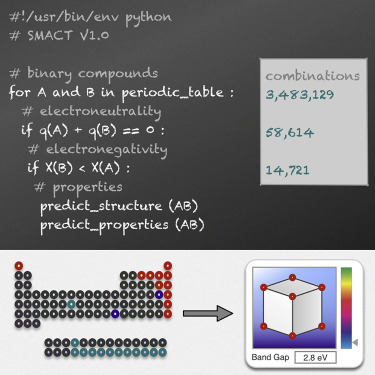
Property Prediction Module#
The property prediction module enables prediction of material properties directly from chemical composition, without requiring crystal structure information. It uses pre-trained ROOST (Representation Learning from Stoichiometry) models to provide fast inference from stoichiometry alone.
The typical workflow is:
Use the convenience function
predict_band_gap()for quick predictions:from smact.property_prediction import predict_band_gap predictions = predict_band_gap(["NaCl", "TiO2", "GaN"])
Or use the
RoostPropertyPredictorclass directly for more control:from smact.property_prediction import RoostPropertyPredictor predictor = RoostPropertyPredictor(property_name="band_gap") result = predictor.predict(["GaN", "ZnO"], return_uncertainty=True)
Query the model registry for available properties and models:
from smact.property_prediction import get_supported_properties, get_available_models

print(get_supported_properties())  # ['band_gap']
print(get_available_models())  # ['Roost-MP-2024.12.0-band_gap']
Installation#
The property prediction module requires additional dependencies that are not installed by default. Install them with:
pip install smact[property_prediction]
This installs aviary-models (>=1.2.0) and PyTorch (>=2.0.0).
Architecture#
The module follows an extensible abstract base class pattern, making it straightforward to add new predictor backends in the future.
BasePropertyPredictor (ABC)
├── predict()             # Abstract — must be implemented
├── supported_properties  # Abstract property
└── _validate_compositions()  # Shared composition validation
     │
     └── RoostPropertyPredictor  # Concrete implementation
          ├── predict()          # ROOST inference with uncertainty
          └── from_checkpoint()  # Load from saved checkpoint
PredictionResult is a dataclass returned when return_uncertainty=True.
It carries predictions, uncertainties, compositions, and unit.
The design is inspired by MatGL’s pretrained model management, following AntObi’s recommendation for model versioning with per-model directories and READMEs.
How ROOST Works#
ROOST (Representation Learning from Stoichiometry) predicts material properties from chemical composition alone, without crystal structure information.
Composition "NaCl"
    │
    ▼
┌─────────────────────────────────────────┐
│ CompositionData                         │
│ Parse formula → elements + weights      │
│ Na: 0.5, Cl: 0.5 → element embeddings  │
└─────────────────────────────────────────┘
    │
    ▼
┌─────────────────────────────────────────┐
│ Message Passing (3 layers)              │
│ Elements exchange information via       │
│ attention-weighted graph neural network │
└─────────────────────────────────────────┘
    │
    ▼
┌─────────────────────────────────────────┐
│ Trunk + Output Networks                 │
│ [1024, 512] → [256, 128, 64] → output  │
│ If robust: also outputs log(std)        │
└─────────────────────────────────────────┘
    │
    ▼
Prediction (+ uncertainty if robust=True)
Key components:
Element embeddings: 200-dimensional MatScholar embeddings capture chemical similarity.
Message passing: Elements in a composition exchange information through 3 graph neural network layers with multi-head attention (3 heads).
Attention pooling: Weighted aggregation of element features into a single composition vector.
Robust loss: Heteroscedastic loss enables per-prediction uncertainty estimates.
Available Models#
Model |
Property |
Dataset |
Test MAE |
|---|---|---|---|
Roost-MP-2024.12.0-band_gap |
Band gap (eV) |
Materials Project 103K |
0.283 eV |
Roost-MP-2024.12.0-band_gap#
The default band gap model was trained on 103,644 DFT (GGA/GGA+U) band gap calculations from the Materials Project.
Training details:
Dataset |
Materials Project (103,644 compositions) |
Split |
82,914 train / 10,365 val / 10,365 test (80/10/10) |
Epochs trained |
232 (early stopping) |
Learning rate |
3e-4 with cosine annealing |
Loss |
Heteroscedastic (robust) L1 |
Performance:
Metric |
Value |
|---|---|
Test MAE |
0.283 eV |
Test RMSE |
0.599 eV |
Val MAE |
0.282 eV |
Baseline comparison (MP test set):
Model |
MAE (eV) |
|---|---|
Mean baseline |
1.361 |
Median baseline |
1.251 |
Linear + Magpie |
0.862 |
Random Forest + Magpie |
0.339 |
ROOST |
0.283 |
ROOST beats RF+Magpie by 17% (0.339 → 0.283 eV), consistent with improvements reported in the original paper.
Known Limitations#
These are fundamental limitations of composition-only prediction, not implementation issues:
Polymorph ambiguity: The same composition can be metallic in one crystal structure and semiconducting in another (e.g. Fe₃O₄ magnetite vs maghemite). ROOST predicts an “average” behaviour across polymorphs.
Metals at zero gap: The MP dataset contains 42% metals (gap=0). Materials with metastable metallic phases may be predicted with a non-zero gap if the semiconducting polymorph is more common in the training data.
Extremes: Both very low (<1 eV) and very high (>7 eV) band gap materials show more scatter, likely due to fewer training examples.
Model Versioning and Fidelity#
The module supports model versioning following the naming convention:
Roost-<dataset>-<version>-<property>[-<fidelity>]
For example: Roost-MP-2024.12.0-band_gap, or in future
Roost-MP-2025.6.0-band_gap-hse06.
The config supports multiple fidelities per property:
# Current (single model):
DEFAULT_MODELS = {
    "band_gap": {
        "default": "Roost-MP-2024.12.0-band_gap",
    },
}

# Future expansion example:
DEFAULT_MODELS = {
    "band_gap": {
        "default": "pbe",
        "pbe": "Roost-MP-2025.6.0-band_gap-pbe",
        "hse06": "Roost-MP-2025.6.0-band_gap-hse06",
    },
}
Fidelity can be selected at construction time:
# Use default fidelity
predictor = RoostPropertyPredictor(property_name="band_gap")

# Select specific fidelity (when multiple are available)
predictor = RoostPropertyPredictor(property_name="band_gap", fidelity="hse06")

# Or specify a model directly by name
predictor = RoostPropertyPredictor(
    property_name="band_gap",
    model_name="Roost-MP-2024.12.0-band_gap",
)
Model Resolution Order#
When loading a model by name, SMACT checks the following locations in order:
Local directory path – if an explicit path is provided.
pretrained_models/ – models bundled in the repository (source installs only).
Cache
~/.cache/smact/models/– previously downloaded models.Remote download – fetched from GitHub releases on first use.
For pip installs (where pretrained_models/ is not included), models are
downloaded automatically on first use and cached locally.
Model Management#
from smact.property_prediction import (
    get_supported_properties,
    get_property_unit,
    get_available_models,
    list_cached_models,
    clear_cache,
)

# List available properties
get_supported_properties()  # ['band_gap']

# Get property unit
get_property_unit("band_gap")  # 'eV'

# List all discoverable models
get_available_models()  # ['Roost-MP-2024.12.0-band_gap']

# List models in local cache
list_cached_models()

# Clear the download cache
clear_cache()
Training New Models#
The module includes a full training pipeline for ROOST models.
Training requires a CSV file with a composition column and a
numeric target column.
Using the Python API:
from smact.property_prediction.roost.train import train_roost_model

model_path = train_roost_model(
    data_path="band_gap_data.csv",
    target_column="band_gap",
    property_name="band_gap",
    output_dir="./trained_models",
    epochs=100,
    batch_size=128,
    learning_rate=3e-4,
    robust=True,  # Enable uncertainty estimation
    device="cuda",  # Use "cpu" if no GPU
)
Using the command line:
python -m smact.property_prediction.roost.train \
    --data-path band_gap_data.csv \
    --target band_gap \
    --property band_gap \
    --output-dir ./trained_models \
    --epochs 100 \
    --batch-size 128 \
    --robust \
    --device cuda
Loading a custom trained model:
from smact.property_prediction import RoostPropertyPredictor

predictor = RoostPropertyPredictor(
    property_name="band_gap",
    model_path="./trained_models/Roost-Custom-band_gap",
)
predictions = predictor.predict(["NaCl", "GaN", "TiO2"])
References#
Goodall, R.E.A. & Lee, A.A. “Predicting materials properties without crystal structure: deep representation learning from stoichiometry.” Nature Communications 11, 6280 (2020). doi:10.1038/s41467-020-19964-7
Jain, A. et al. “Commentary: The Materials Project: A materials genome approach to accelerating materials innovation.” APL Materials 1, 011002 (2013). doi:10.1063/1.4812323
Submodules#
- smact.property_prediction.base_predictor module
BasePropertyPredictorPredictionResultPredictionResult.predictionsPredictionResult.uncertaintiesPredictionResult.epistemic_stdPredictionResult.unitPredictionResult.compositionsPredictionResult.compositionsPredictionResult.epistemic_stdPredictionResult.predictionsPredictionResult.to_dict()PredictionResult.uncertaintiesPredictionResult.unit
- smact.property_prediction.convenience module
- smact.property_prediction.config module
- smact.property_prediction.io module
- smact.property_prediction.registry module
- smact.property_prediction.roost module